From Noise to Stillness: A Journey to Inner Peace

Updated: Mar 16
We inhabit an age defined by perpetual stimulation. Notifications vibrate with mechanical urgency, traffic generates an unceasing acoustic backdrop, artificial light extends the day deep into the night, and the human mind—conditioned by constant input—rarely experiences genuine repose. Noise, therefore, is no longer merely environmental; it has become psychological. The contemporary individual carries within a ceaseless interior monologue shaped by anxiety, comparison, unfinished tasks, and fragmented attention.
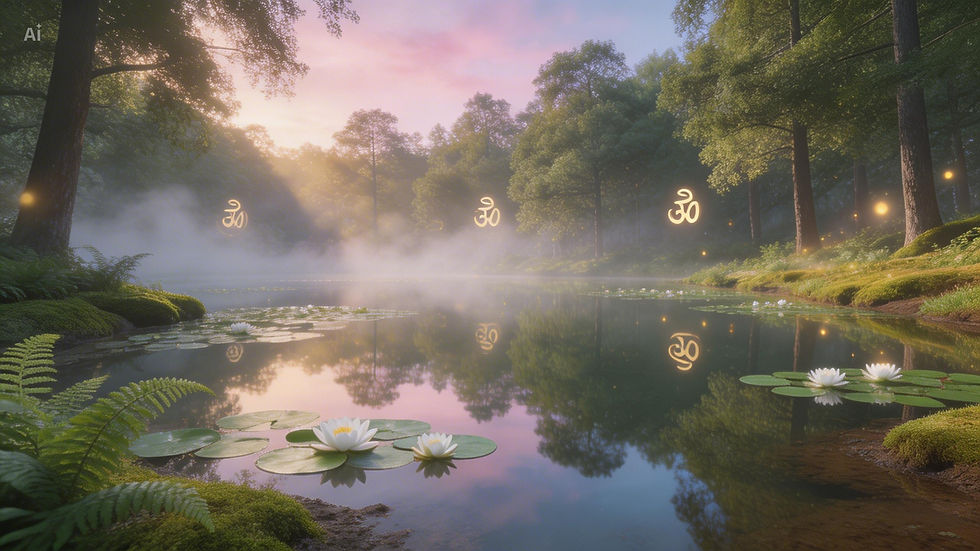
In such a condition, peace cannot be achieved through external rearrangement alone. The wisdom traditions of humanity consistently affirm that tranquillity arises not from controlling circumstances but from disciplining consciousness. At Sadhana Sansar, this principle is central: a truly “simple world” is not geographically remote but inwardly cultivated, emerging within the silent sanctuary of the awakened mind. Long before digital technologies complicated human attention, Indian philosophical literature explored the nature of mental turbulence and the path toward interior stillness.
From Noise to Stillness: A Journey to Inner Peace
Explore 'From Noise to Stillness: A Journey to Inner Peace' and discover how to cultivate inner peace. Start your journey to inner peace today.
The Nature of True Silence
Silence, in the classical Indian understanding, is not reducible to the absence of sound. It is better conceived as a heightened state of awareness in which the mind ceases to project its habitual distortions. The forest hermitages described in the Upanishads were not sought merely for acoustic quietude but for their capacity to facilitate contemplative absorption. When the senses are subdued, and the mind is no longer agitated by desire or fear, reality is perceived with clarity. A frequently cited declaration from the Taittiriya Upanishad expresses the ineffability of ultimate truth:
“Yato vāco nivartante aprāpya manasā saha”—“From which words return, along with the mind, unable to grasp the true silence.”
The statement implies that ultimate reality lies beyond discursive thought; intellectual proliferation cannot apprehend it. Silence, therefore, is epistemological as well as psychological: it is the condition under which knowledge of the highest order becomes possible. The restless mind functions like disturbed water, fragmenting the reflection of truth, whereas a tranquil mind reflects it whole.
Recognising the Multidimensional Character of Noise
Modern noise operates on several interconnected levels. Physical disturbances—urban traffic, machinery, crowded environments—constitute the most obvious layer, yet they are not necessarily the most disruptive. Digital noise, generated by the incessant flow of information through screens, fragments attention and produces a state of perpetual alertness. More insidious still is mental noise: anticipatory anxiety, rumination over past events, and the compulsion to evaluate oneself against others. Classical Indian psychology recognised this interior turbulence long before contemporary cognitive science. In the Bhagavad Gita, Arjuna confesses to Krishna that the mind is
“The mind is restless, turbulent, powerful, and stubborn.”— Bhagavad Gita 6.34
comparing its volatility to that of the wind. Krishna’s response is neither dismissive nor fatalistic; he prescribes disciplined practice (abhyāsa) combined with detachment (vairāgya) as the means of mastery.
“By practice and detachment, it can be controlled.”— Bhagavad Gita 6.35
Silence, therefore, is not a passive state that occurs spontaneously but the outcome of sustained training. It is cultivated through deliberate withdrawal from compulsive engagement with stimuli.
Intentional Pauses as Spiritual Practice
Contrary to popular imagination, attaining inner quiet does not require physical seclusion in remote landscapes. What is required is intentional interruption of habitual reactivity. Brief intervals of stillness—what may be termed “quiet pockets”—can function as micro-practices of contemplative discipline. For example, beginning the day without immediate exposure to digital input allows the mind to stabilise before it becomes entangled in external demands. Similarly, concluding the day in silence permits cognitive and emotional residues to settle. The Bhagavad Gita describes the meditative state as one in which the restrained mind rests in the Self alone, experiencing profound contentment.
“When the mind, restrained by practice, rests in the Self alone, one experiences supreme peace.”— Bhagavad Gita 6.20–21
Such passages suggest that peace is cumulative: repeated moments of stillness gradually reshape the mental landscape, making tranquillity the default rather than the exception.
Digital Detachment and the Discipline of the Senses
The proliferation of digital devices has intensified the classical problem of sensory distraction. Yogic philosophy designates the withdrawal of the senses from external objects as pratyāhāra, a prerequisite for deeper meditative states. In the Katha Upanishad, the human condition is illustrated through the metaphor of a chariot: the senses are the horses, the mind the reins, and the intellect the charioteer.

If the horses are unrestrained, the chariot veers chaotically, endangering the traveller. Modern notification systems function analogously to stimuli that continually tug at the sensory apparatus, preventing sustained attention. Practices such as disabling nonessential alerts, establishing device-free periods, or refraining from simultaneous media consumption during routine activities serve not merely as lifestyle adjustments but as contemporary forms of ascetic discipline. Through them, the individual reasserts sovereignty over attention.
Nature as a Medium of Restoration
While ultimate silence is internal, natural environments provide conditions conducive to its emergence. Unlike artificial stimuli, which compete aggressively for attention, natural phenomena operate at rhythms harmonious with human physiology. The sound of wind through foliage or water in motion possesses a regularity that tends to entrain rather than agitate the nervous system. Traditional Indian culture recognised forests as Tapovan—literally “forests of austerity”—where contemplatives cultivated spiritual intensity through communion with nature. Contemporary research in environmental psychology corroborates this intuition, demonstrating that exposure to natural settings reduces stress markers and enhances cognitive clarity. Engaging with nature without technological mediation—walking without headphones, observing the sky, sitting beneath a tree—allows perception to broaden and mental chatter to subside.
Inner Stillness as the Highest Silence
External quiet, sensory discipline, and environmental support are preparatory conditions; the culmination is the attenuation of the internal narrative itself. The Mandukya Upanishad describes the fourth state of consciousness, Turiya, not as unconsciousness but as pure awareness beyond waking, dreaming, and deep sleep. It characterises this state with the terms śānta (peaceful), śivam (auspicious), and advaita (non-dual).
“Shanta, Shivam, Advaita”Peaceful, auspicious, non-dual.
Here, silence is not emptiness but plenitude—a fullness in which the usual subject-object division dissolves. The individual no longer experiences reality as fragmented or threatening; instead, there is an intuitive sense of completeness. Such silence cannot be produced mechanically, but it can be approached through sustained contemplative practice.
The Contemporary Relevance of Silence
The urgency of cultivating silence today stems from its psychological and ethical consequences. Without intervals of stillness, individuals become reactive rather than reflective, consuming information without assimilating it and pursuing activity without purpose. The absence of inner quiet correlates with diminished empathy, impaired judgment, and chronic dissatisfaction. Conversely, silence fosters clarity of perception, emotional regulation, creativity, and spiritual insight. It restores the capacity to respond thoughtfully rather than impulsively. In this sense, silence is not escapism but a prerequisite for responsible engagement with the world.
Concluding Reflection
Silence, properly understood, is not withdrawal from life but entry into its deepest dimension. As the turbulence of mental activity subsides, one discovers that peace was never absent; it was obscured by incessant distraction. The contemplative traditions of India consistently affirm that the Self reveals itself not through the accumulation of experiences but through the cessation of agitation. When the mind becomes still, awareness shines unobstructed, as the moon reflected in a tranquil lake. Thus, reclaiming silence is less an acquisition than a recovery—the rediscovery of a native state of being that modern conditions have rendered unfamiliar but not inaccessible.
In this light, silence is not the negation of sound or activity; it is the ground from which meaningful sound and purposeful action arise.
“In the stillness of the mind, the Self reveals itself.”
Or as a modern reflection beautifully puts it:
Silence is not the absence of something — it is the presence of everything.
FAQ: Navigating the Silence
Q: Is silence the same as loneliness? A: Not at all. Loneliness is a feeling of isolation, while silence (or solitude) is a state of being at peace with oneself. Choosing silence is an act of self-care, not a withdrawal from others.
Q: I find silence uncomfortable. Why? A: When the external noise stops, our internal "noise" often gets louder. If you find silence uncomfortable, it’s usually because your brain isn't used to processing thoughts without distraction. Start small—even two minutes a day helps build "silence stamina."
Q: Do I need noise-cancelling headphones? A: They are a great tool for physical noise, especially in offices or on commutes. However, don't rely on them to do all the work. Real silence is an internal shift, not just a hardware setting.
Q: Can I find silence while being busy? A: Yes. Silence is a mental state. You can find "inner silence" while washing dishes or walking to the store simply by focusing entirely on the task at hand and letting go of the mental chatter.


Comments