When the Vedas Meet Science: Modern Discoveries

For centuries, the Vedas were dismissed by many as mystical poetry—beautiful, symbolic, and spiritually profound, yet scientifically irrelevant. Today, that perception is quietly changing. As modern science probes deeper into the nature of reality—into quantum fields, cosmic origins, consciousness, and time itself—it is encountering ideas that sound uncannily familiar to students of ancient Indian wisdom.
Were the Vedic seers primitive myth-makers, or keen observers of reality using a different language—one of symbols, intuition, and inner perception rather than instruments and equations?
When the Vedas Meet Science: Modern Discoveries
Discover how "When the Vedas Meet Science: Modern Discoveries" bridges ancient wisdom with today's scientific breakthroughs. Explore the convergence now!
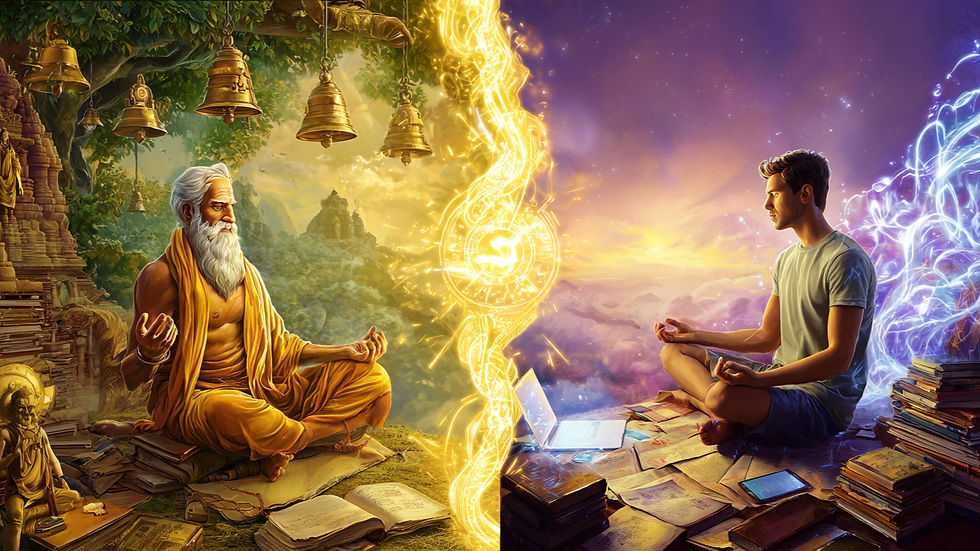
Across cosmology, physics, biology, and neuroscience, researchers are discovering that several foundational concepts explored today were contemplated in astonishing depth thousands of years ago. This does not mean the Vedas were “science textbooks” in the modern sense. Rather, they present a philosophical-cosmic vision that sometimes parallels scientific discoveries in striking ways.
Below are ten profound Vedic insights that modern science is actively exploring, debating, or partially confirming.
1. Multiverse: Ananta Koti Brahmanda
Long before modern cosmology proposed multiple universes, ancient texts described reality as containing countless cosmic systems.
The Atharva Veda and Bhagavata Purana speak of “Ananta Koti Brahmanda” — infinite universes existing simultaneously, emerging and dissolving in cycles.
Modern Parallel: The Inflationary Multiverse and Many-Worlds Interpretation suggest that our universe may be one “bubble” in a vast cosmic foam of universes.
2. Speed of Light: Sayana’s Remarkable Calculation
In a medieval commentary on the Rig Veda, scholar Sāyaṇa described the sun as traversing 2,202 yojanas in half a nimesha.
When ancient units are converted:
1 yojana ≈ 9.09 miles
1 Nimesha ≈ 0.2112 seconds
This yields approximately 189,547 miles per second, astonishingly close to the modern value of light speed (186,282 miles/s).
While scholars debate interpretation and intent, the numerical proximity continues to fascinate historians of science.
3. Cosmic Creation: Big Bang and Cyclical Time
The Nasadiya Sukta describes a primordial state beyond existence and non-existence, followed by emergence from intense heat—themes that echo those of the cosmic origin myth.
Vedic cosmology also proposes cyclic creation:
Expansion (creation)
Sustenance
Dissolution (Pralaya)
Re-creation
Modern Parallel: Big Bang theory, cyclic universe models, and “Big Bounce” hypotheses.
4. Relativity of Time: Kalpas and Cosmic Scales
Ancient texts describe time as relative, not absolute.
A “day of Brahma” (Kalpa) equals 4.32 billion years, remarkably close to Earth’s estimated age (~4.54 billion years).
Stories of travellers visiting higher realms and returning to find centuries have passed on Earth resemble time-dilation scenarios.
Modern Parallel: Einstein’s relativity shows that time slows near massive gravity or at high velocity.
5. Quantum Interconnectedness: Brahman and Atman
The Upanishads teach:
The individual Self (Atman) is identical with the universal reality (Brahman).
This suggests a universe fundamentally unified beneath apparent separateness.
Modern Parallel: Quantum entanglement — where particles remain correlated across vast distances.
Physicist Erwin Schrödinger openly acknowledged inspiration from Vedantic philosophy when grappling with quantum theory.
6. Atomic Theory: The Concept of Anu
The Vaisheshika school proposed that matter consists of indivisible particles called anu (atoms).
Sage Kanada suggested atoms combine in fixed proportions to form complex substances—centuries before modern chemistry.
Modern Parallel: Atomic theory and molecular bonding.
7. Biological Rhythms: Brahma Muhurta
Vedic tradition emphasises rising during Brahma Muhurta — about 90 minutes before sunrise — claiming it optimises physical and mental functioning.
Modern Parallel: Research on circadian rhythms shows human physiology is deeply synchronised with solar cycles. The 2017 Nobel Prize in Medicine recognised discoveries about these internal biological clocks.
8. Primordial Vibration: Sound as the Basis of Reality
The Vedas declare that creation began with the sacred syllable Aum — not merely as sound, but as cosmic vibration.
Modern Parallels:
String theory proposes fundamental vibrating strings as the building blocks of matter.
Cymatics demonstrates how vibration organises physical patterns
The concept of Nada Brahma — “the universe is sound” — resonates strongly with these ideas.
9. Sacred Geometry: The Sri Yantra
The Sri Yantra consists of nine interlocking triangles forming 43 smaller ones in precise mathematical harmony.
Modern analysis reveals:
Complex symmetry
Fractal-like structure
Geometric precision requires advanced spatial understanding.
Modern Parallel: Fractal geometry and holographic models of the universe.
10. Evolutionary Symbolism: Dashavatara
The Garuda Purana describes the ten incarnations of Vishnu, which intriguingly mirror stages of biological evolution:
Matsya — aquatic life
Kurma — amphibious transition
Varaha — terrestrial mammals
Narasimha — proto-hominid symbolism
Vamana — early human
Later avatars — cultural and intellectual development
This sequence parallels themes later formalised by Charles Darwin in evolutionary theory.
11. Akasha: The Energy of “Empty” Space
Vedic philosophy describes Akasha as the subtlest element — an all-pervading field from which matter arises.
Modern Parallel: Quantum field theory shows that the vacuum is not empty but filled with fluctuating energy—the Zero-Point Field.
Two Paths Toward One Reality
Science advances through measurement, experimentation, and mathematical modelling. The Vedic tradition advances through meditation, introspection, and philosophical inquiry. Yet both seek the same goal: understanding the nature of existence.
The similarities between ancient insights and modern discoveries should not be reduced to simplistic claims that “the Vedas predicted everything.” Rather, they suggest that human inquiry — whether inward or outward — can converge on profound truths about reality.
The Vedic seers did not merely observe the world; they sought to experience its underlying unity. Modern science, armed with particle accelerators and space telescopes, is now approaching that same frontier from the opposite direction.
Perhaps the most important lesson is this:
Truth is not owned by any era. It reveals itself gradually — through intuition, contemplation, experiment, and discovery.
In that sense, the dialogue between the Vedas and modern science is not a competition, but a convergence — a reminder that humanity’s quest to understand the cosmos is as ancient as it is ongoing.


Comments