Meditation as the Breath of Devotion

Updated: Apr 5
Many seekers today find themselves asking, "How do I meditate?" The mind wanders restlessly, running from one thought to another, clinging to worries, memories, or desires. Scriptures across the ages, from the Vedas to the Bhagavad Gita, offer a simple yet profound answer: meditate on God. By fixing the mind on the Divine, the impossible becomes possible, and the unattainable becomes attainable. This practice is known as Rūpa-Dhyāna, or meditation on the form of God.

Scriptural Authority
Across the landscape of sacred texts, one teaching shines with striking clarity: to meditate on God is the soul’s highest calling. Sage Vedavyasa, after delving into the six systems of philosophy and distilling the essence of the Puranas, declared that the ultimate wisdom is simply this: fix the mind on Narayana and dwell upon Hari. Even Brahma, after churning the ocean of the Vedas again and again, arrived at the same realisation: no practice equals meditation on the Divine. The Ramayana echoes this truth, reminding us that remembrance of God is not a side path but the lifeblood of devotion itself. Seen together, these voices form a chorus across time, affirming that Rūpa-Dhyāna is not just one among many practices—it is the very heartbeat of spiritual life.
Meditation as the Breath of Devotion
"Meditation as the Breath of Devotion". Just as the body cannot survive without breath, devotion cannot endure without meditation. It is meditation that gives life to worship, just as the heart gives pulse to the body. The Gita resounds with this call: “Fix your mind on Me, think of Me alone, surrender yourself to Me.” Without the mind’s participation, chanting becomes mere sound, rituals mere movement, hymns mere words. However grand the outward show, it remains empty if the heart is elsewhere. But when the mind is centred on the Divine, every act of devotion glows with meaning. It is meditation that turns routine into worship and transforms ritual into living love.
Who Meditates? The Role of the Mind
Meditation does not belong to the eyes that see, the ears that hear, or the tongue that speaks. Each sense moves within its own small circle of action, but none can touch the depth of the spirit. The act of meditation begins where the senses fall silent—it is the quiet labour of the mind, the gentle turning of the heart inward. True worship, therefore, is not found in what the eyes behold or what the lips recite, but in where the mind chooses to rest. When thought itself bows before the Divine, then devotion becomes alive, and the unseen presence of God begins to shine within.
The Challenge of Meditating on the Infinite
Here lies the true paradox of devotion: how can the finite comprehend the Infinite? The Divine cannot be captured by the senses, nor held within the narrow corridors of thought. Even the intellect, proud of its subtlety, falters before the boundless.
Consider this—our mind, though intimate with worldly forms, cannot recall them in perfect detail. Try as we may, who can summon before the inner eye the precise curve of a father’s ear, or the delicate contour of a mother’s smile? If such fleeting, tangible forms escape our grasp, how can the mind conceive the perfection of the Eternal?
Left to our own devices, it is beyond reach. The Infinite reveals Itself not through effort, but through grace—when the heart becomes still, when longing ripens into surrender, and the veil of limitation gently lifts.
Saints Show Us the Path
And yet, the lives of saints stand as luminous proof that the impossible becomes possible when the heart burns with divine longing and is touched by grace. Saints like Tulsidas, Surdas, Meera, Kabir, Nanak, and Tukaram walked this very path — not by intellect or reasoning, but by the fire of love that consumed all else.
Tulsidas began as an ordinary man, bound by worldly affection. But one piercing moment of truth turned his life toward eternity — when his wife’s rebuke unveiled to him the folly of misplaced devotion. The same passion that once chained him to the transient became the force that lifted him toward the Infinite. His heart, once restless, found its single purpose: to behold the Beloved within. And in that very life, his yearning flowered into divine vision.
These tales remind us that though the mind is small, when flooded with pure love and surrendered to the Divine will, it becomes a vessel vast enough to hold the Infinite. Ultimately, it is not through thinking that God is perceived, but through love.
God’s Compassionate Acceptance
Out of boundless compassion, the Divine makes a tender assurance to every seeker: “However you behold Me in your heart, I shall come to you in that very form.” Such is the generosity of God’s love that He bends Himself to the shape of our devotion.
We need not tremble before the thought of imperfection — for no human mind can paint the Infinite without error. Whether we envision Him with two arms or four, as a playful child or a sovereign Lord, radiant or dark as the monsoon cloud — all are accepted, all are blessed.
What calls God forth is not the precision of our imagination, but the purity of our love. The Divine does not measure the angles of our vision; He listens to the pulse of the heart that beats for Him. To love Him sincerely is to see Him truly — for where love abides, there the Lord willingly reveals Himself.

The Role of Idols and Images
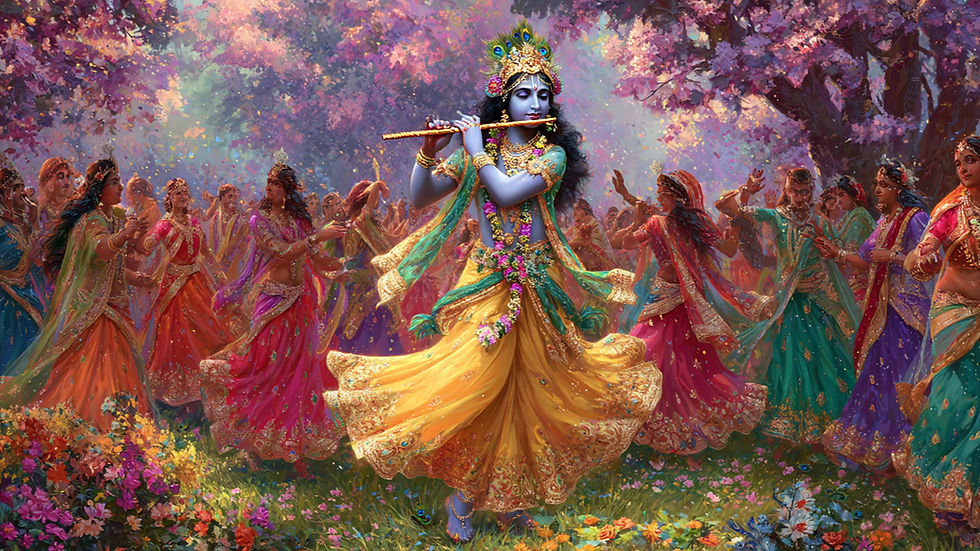
Since the restless mind finds it hard to dwell upon what it cannot see, the merciful Lord allows form to become our doorway to the formless. The image, the idol, the sacred picture—all these serve as gentle anchors for our wandering thoughts. When we gaze upon the deity and then close our eyes to hold that vision within, we begin the art of inward seeing. Each return of the mind to that divine image strengthens its bond with the Beloved.
Thus, what begins as external worship ripens, in time, into silent meditation. The hands that once adorned the altar learn to adorn the heart. Even the simple acts of service—offering a flower, lighting a lamp, or placing food before the Lord—are not burdens of ritual, but expressions of love. The Divine is not pleased by the perfection of form, but by the fragrance of feeling. Whether the offering be grand or humble, intricate or plain, He accepts it when it springs from a heart of devotion. For in the realm of love, it is not the ritual that sanctifies the heart—it is the heart that sanctifies the ritual.
Purification Through Remembrance
To think of God is not merely to concentrate—it is to cleanse. When the mind turns again and again toward the Divine, the heart begins to shine with an inner light. The Padma Purana proclaims that whether one be pure or impure, the moment one remembers the Lord, purity arises both within and without. Water and soap may wash away the dust of the skin, but only remembrance can dissolve the stains of sorrow, restlessness, and delusion.
Wherever the Divine is remembered, that place becomes holy. Even the darkest corner brightens under His name, for impurity cannot cling to Him—He transforms all it touches. Thus, meditation on God’s form is not confined by time, place, or condition. It needs no temple, no elaborate rite—only a yearning heart. Wherever love remembers, God is present.
The Highest Practice
Among all spiritual disciplines, Rūpa-Dhyāna—meditation upon the Divine Form—stands as both the gentlest and the loftiest path. It asks for nothing but a heart that loves to behold its Beloved. As the mind lingers upon that sacred image, it is slowly refined, its impurities melting away like frost before the morning sun. And when divine grace descends, that same mind, once restless and ordinary, becomes illumined and divine.
Such meditation does not merely bring glimpses of peace; it leads to realisation itself. The vision of God attained through this practice is not fleeting—it is an eternal possession, untouched by time or death. Worldly attainments fade like footprints in the sand, but the treasure of divine remembrance endures forever in the soul, a light that never dims, a joy that never ends.
Conclusion
From the sacred depths of every scripture, from the songs of saints and the silence of sages, one truth resounds with unbroken clarity: Fix your heart upon the Divine Form. This alone is the essence of devotion, the pulse of worship, the life of the spirit. Meditation on God’s form is not one path among many—it is the very breath of love itself.
For in the end, God is not attained by the precision of our imagination but by the tenderness of our longing. The Divine does not ask how flawless our vision is, but how sincere our love has become. When the mind, weary of the world, turns again and again toward His radiant image, a miracle unfolds—the heart itself begins to take on His likeness.
And when that heart, made pure by remembrance, finally beholds the Beloved face to face, there remains no separation—only love, only light, only Him. May our wandering thoughts find rest at His lotus feet, and may every breath become a silent song of praise.
Glory to the Beloved Lord—eternal, compassionate, and ever near.
FAQs
1. What is the concept of "Meditation as the Breath of Devotion"?
This concept emphasises integrating meditation into one's spiritual practice, viewing it as essential for cultivating devotion and deepening one's connection to the divine.
2. How can meditation enhance devotion?
Meditation helps quiet the mind, allowing individuals to focus on their spiritual intentions and connect more deeply with their beliefs and practices, thereby enhancing their sense of devotion.
3. What types of meditation are best for cultivating devotion?
Mindfulness meditation
Loving-kindness meditation
Mantra meditation
Visualization practices
4. How long should one meditate to experience its benefits?
Even short sessions of 5-10 minutes can be beneficial. However, longer sessions (20-30 minutes) may deepen the experience of devotion and connection.
5. Can meditation be practised alongside other forms of devotion?
Yes, meditation can complement other practices such as prayer, chanting, or ritual, enhancing the overall spiritual experience.
6. What challenges might one face when meditating for devotion?
Common challenges include a wandering mind, difficulty in maintaining focus, and emotional resistance. Regular practice and patience can help overcome these obstacles.
7. Is there a specific time of day that is best for meditation?
8. How can one stay motivated to meditate regularly?
Set a consistent schedule
Join a meditation group
Keep a journal to track progress
Remind yourself of the benefits
9. Are there any recommended resources for beginners?
Books, online courses, and guided meditation apps can be great resources for beginners looking to explore meditation as a form of devotion.
10. How can one measure the impact of meditation on their devotion?
Reflection on personal experiences, emotional changes, and the depth of spiritual connection can help gauge the impact of meditation on one's devotional practice.


Comments