Can any seeker really escape the magic of Mahamaya?

The Durga Sapta Shloki is a revered set of seven verses traditionally attributed to the Markandeya Purana (Devi Mahatmya) and offers a concise yet profound essence of the Goddess’s role in cosmic order. These verses are often described as the "heart of the Devi Mahatmya", encapsulating the power, compassion, and omnipresence of the Divine Mother.
While the Devi Mahatmya itself spans 700 verses (Saptashati), the Sapta Shloki serves as its distilled essence. According to tradition, Lord Shiva himself imparted these seven verses to Parvati, declaring that reciting them with devotion is equivalent to reciting the entire Chandi Path (Devi Mahatmya).
The Sapta Shloki, therefore, holds a unique theological status:
It presents Devi as both Mahamaya (the deluding power) and Mahashakti (the liberating force).
It bridges philosophy (Vedanta) with devotion (Bhakti).
It serves as a practical manual for daily worship and spiritual resilience.
Can any seeker really escape the magic of Mahamaya?
"Can any seeker really escape the magic of Mahamaya?"-Can any seeker truly escape the mysterious spell of Mahāmāyā — the great cosmic enchantress who weaves the fabric of existence itself? Every spiritual path speaks of liberation, of seeing through illusion to the one eternal truth. Yet, in the heart of every scripture lies this profound reminder: even the wisest, even the saints who have glimpsed the Absolute, are not entirely free from Her touch.
Mahāmāyā is not merely illusion — she is the Divine Mother, the power through which the One becomes the many, and the infinite expresses itself as the world. Her magic is not deception but divine artistry. She veils the Truth not to deny it, but to allow each soul to rediscover it through experience, surrender, and grace.
Here, we will understand only the first verse.
For this sacred mantra, the Durga Sapta Shloki Stotra, the seer (ṛṣi) is Narayana; the meter (chandas) is Anuṣṭup; the presiding deities are Mahākālī, Mahālakṣmī, and Mahāsarasvatī. This recitation of the Durga Sapta Shloki is performed for the pleasure and propitiation of Goddess Durga.
ज्ञानिनामपि चेतांसि देवी भगवती हि सा ।
बलादाकृष्य मोहाय महामाया प्रयच्छति ॥ १ ॥
“That Goddess, the Supreme Bhagavatī Herself, as Mahāmāyā, seizes even the minds of the wise and, with irresistible power, casts them into delusion.”
The Divine Mother, the Supreme Being, as Mahamaya herself, captivates the minds of the wise with her Indomitable power.

This opening verse of the Durga Sapta Shloki introduces us to the paradoxical majesty of the Divine Mother. She is Mahāmāyā—the Great Power of Illusion—through whom the cosmic play unfolds. Far from being a simple trick of the senses, Māyā is the sacred force that veils the Absolute and projects the universe of multiplicity. Without her, creation could not be sustained; through her, both bondage and liberation are woven into the fabric of existence.
The shloka makes a striking claim: even the wisest beings, the jñānīs who have studied scriptures, meditated deeply, and glimpsed the truth of the Self, are not beyond her reach. With her irresistible power (balād ākṛṣya), she can draw their minds into delusion. This is not merely a warning but a revelation: no human effort, however refined, is complete without the grace of the Divine. Knowledge alone is not the final safeguard. The Mother, who grants wisdom, also tests it by clouding the intellect when pride or subtle desires linger.
The Bhagavad Gītā echoes this truth: “This divine Māyā of Mine, made of the three guṇas, is hard to overcome; but those who take refuge in Me cross beyond it.”
दैवी ह्येषा गुणमयी मम माया दुरत्यया |
मामेव ये प्रपद्यन्ते मायामेतां तरन्ति ते || 7.14||
The implication is clear—liberation cannot be wrestled into being through ego or intellect. It is received as grace, a gift from the Mother who governs both concealment and revelation.
For the spiritual seeker, this verse is a call to humility. No matter how advanced one may feel on the path, vigilance and surrender remain essential. The Divine Mother holds the power to veil or unveil truth, and it is only through devotion, faith, and surrender that one can stay established in wisdom.
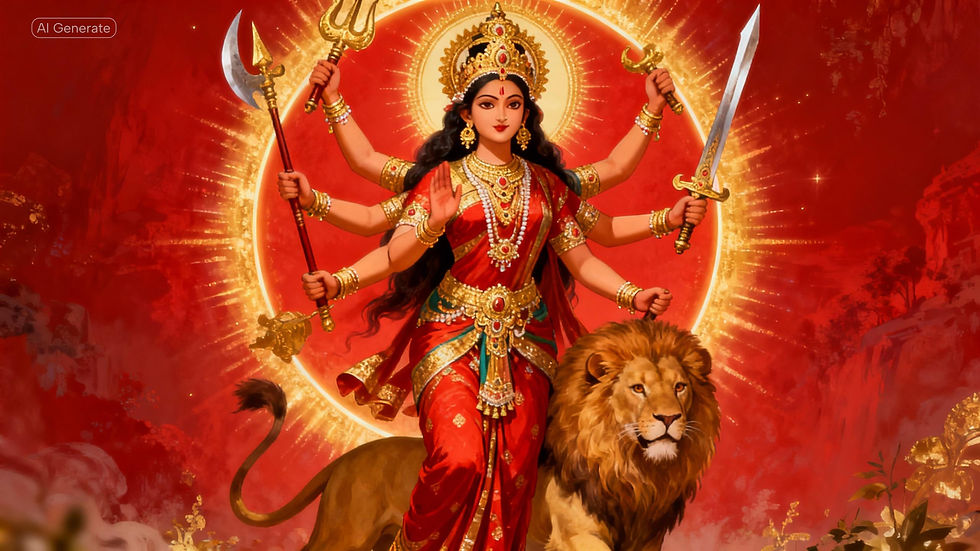
The deeper insight here is that Māyā is not an enemy to be conquered but the Mother herself. She is the veil and the unveiling, the delusion and the liberation. To bow before her is to accept that every step of the journey—confusion, clarity, bondage, freedom—is part of her compassionate play.
Thus, the first shloka of the Sapta Shloki is not merely a description of Māyā’s power; it is an invitation to humility, devotion, and trust. The seeker is reminded that the Divine Mother alone leads beyond illusion, and to her, the eternal source of both concealment and grace, we offer our reverence.
"She is the veil and She is the unveiling; She is the delusion and She is the liberation. To Her, the Mother of the Universe, we bow.”
The first verse of the Durga Sapta Shloki reminds us that the Divine Mother is both the mystery and the revealer of truth. Her power, Mahāmāyā, governs the entire cosmos — guiding, testing, and ultimately liberating every soul. As seekers, when we bow to Her with humility and devotion, we move beyond illusion into the light of true wisdom.
Mahāmāyā, the Great Cosmic Mother, tests the devotee not to punish but to awaken. Through loss, silence, and uncertainty, she asks the heart: “Do you seek Me for comfort, or for truth?” Her trials strip away illusion, shaping faith into pure surrender. She is both the veil and the revelation — the power that challenges and the grace that uplifts. In testing devotion, Mahāmāyā leads the seeker beyond fear, into the light of unshakable trust.


Comments